

Why you feel on edge
One shift changes how you respond.
You feel on edge.
Tight.
Alert for no clear reason.
Nothing is wrong.
But nothing feels settled either.
Most founders treat this as a problem.
Something to suppress.
Ignore.
Push through.
That’s where it breaks.
After working with founders, one pattern repeats:
Stress isn’t a failure, it’s a signal.
Not random.
Not noise.
Directional.
When it’s ignored, it escalates.
When it’s interpreted, it resolves.
Stress shows up when something is misaligned.
Too much input.
Unclear priorities.
Unresolved decisions.
Accumulated recovery debt.
Your system isn’t collapsing.
It’s asking for calibration.
This is not about removing stress.
It’s about reading it correctly.
The Stress Read Protocol
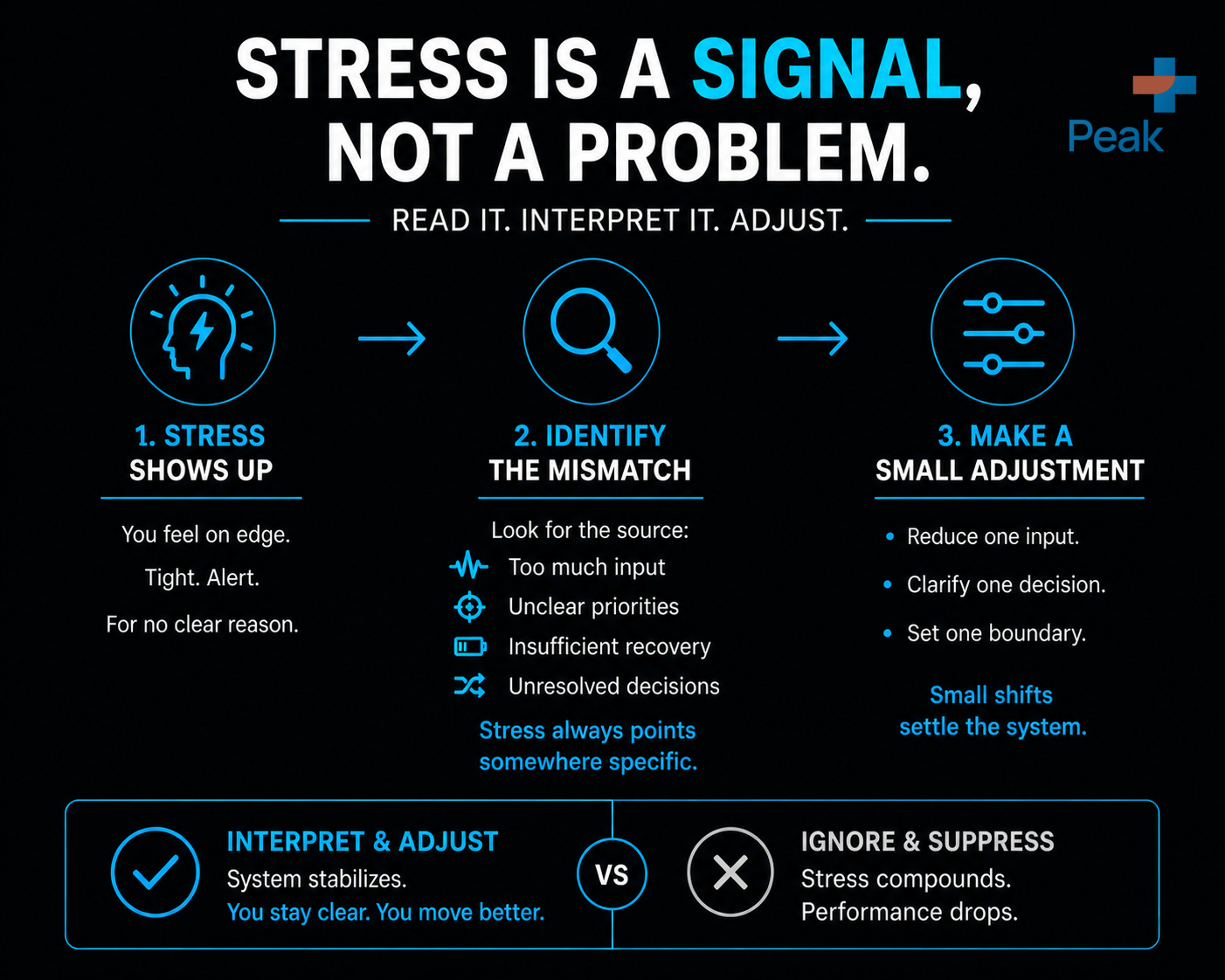
Pause the Narrative
Stop asking, “What’s wrong with me?”
Ask instead: “What changed?”
Identify the Mismatch
Where is the pressure coming from?
Input load.
Decision weight.
Lack of recovery.
Context switching.
Stress always points somewhere specific.
Make a Small Adjustment
Reduce one input.
Clarify one decision.
Set one boundary.
Small shifts settle the system.
Stress points → you adjust → system stabilizes.
Ignore it → suppress it → it compounds.
Quick question:
When stress shows up, what do you default to, push, ignore, or adjust?
If this resonated, tap like and comment below.
I’m using your responses to shape the next Peak Protocol system.